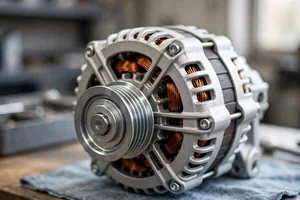
You can tell your alternator is bad when your lights dim, the battery warning light comes on, the battery dies soon after a jump start, or you hear a whining noise. A healthy alternator keeps the battery charged at 13.8 to 14.7 volts while the engine runs. This guide covers the warning signs, a home multimeter test, the causes, and the 2026 replacement cost.
Your car starts fine one morning and struggles the next. That pattern confuses a lot of drivers, and it is often the alternator at fault. Learning how to tell if your alternator is bad can save you from a dead battery on the road and a much bigger repair bill.
The alternator makes power while your engine runs. It charges the battery and runs your lights, radio, air conditioning, and heated seats. When it starts to fail, those systems lose power one by one.
In this guide you will learn the signs to watch for, the exact voltage test to run at home, what causes the failure, what a new alternator costs in the US in 2026, and when you should stop driving.
What are the signs your alternator is bad?

The most common signs your alternator is bad are dim or flickering lights, a battery warning light on the dash, a dead battery after a jump start, a whining or grinding noise, a burning rubber smell, and slow power accessories.
- Dim or flickering headlights are an early warning – Your headlights may look weak at idle and brighten when you press the gas. That change happens because the alternator cannot hold a steady output. One driver in Ohio noticed his dash lights dimmed each time he turned on the heater, and a new alternator fixed it the same day.
- The battery warning light comes on and stays on – The light looks like a small battery, and it means the charging system is not working right. Do not ignore it for days, since the battery drains a little more on every trip. A bad oxygen sensor symptoms guide can help you tell a check engine light apart from this battery light.
- The battery dies soon after a jump start – A jump start gives the battery a short boost, but a bad alternator cannot refill it. If the car dies again within a few hours or the next morning, the alternator is the likely cause.
- You hear a whining or grinding noise from the engine – A worn bearing inside the alternator makes a high whine that rises with engine speed. A grinding sound means the bearing is close to seizing, and you should get it checked within a day or two.
- You smell burning rubber under the hood – A slipping or worn belt can overheat and smell like burnt rubber. Our guide to a car smells like burning rubber shows how to trace that smell to the right part.
- Power windows, seats, and radio run slow or cut out – These accessories need full voltage to work right. When the alternator output drops, the windows crawl and the radio may cut out at idle.
Lights, noise, and smell together
One sign alone can mislead you, but two or three signs together point to the alternator. Dim lights plus a battery light plus a whine is a clear pattern. Write down what you notice and when it happens, since that detail helps a mechanic find the fault fast.
How can you test your alternator at home?
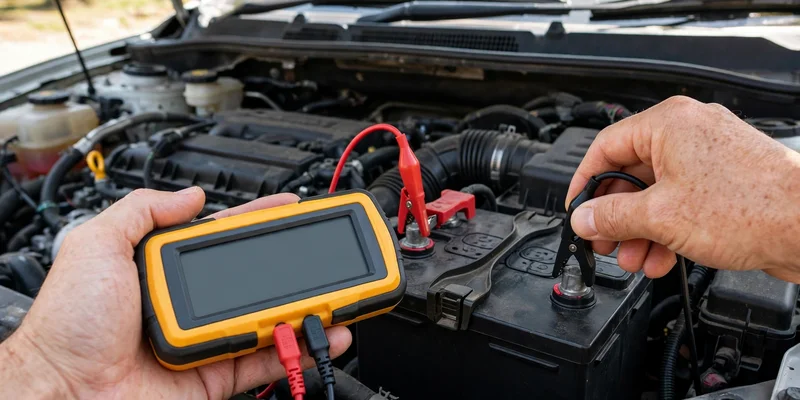
You can test your alternator at home with a digital multimeter. A healthy alternator shows 13.8 to 14.7 volts with the engine running. A reading under 13 volts with the engine running points to a bad alternator.
- Test the battery first with the engine off – Set the multimeter to DC volts and touch the red probe to the positive terminal and the black probe to the negative terminal. A healthy battery reads 12.4 to 12.7 volts. A reading under 12.2 volts means the battery is low before you even start the car.
- Start the engine and test again at the battery – The reading should climb to 13.8 to 14.7 volts within a minute. That rise proves the alternator is charging. If the reading stays near 12 volts or falls while the engine runs, the alternator is not doing its job.
- Turn on the lights, heater, and radio and test once more – A good alternator holds 13.5 volts or more with the load on. If the voltage drops under 13 volts with the accessories on, the alternator is weak and will fail soon.
- Listen and watch while you test – A whine that rises with engine speed plus a low voltage reading is strong proof. An Autel diagnostic tool can read the same charging data through the OBD2 port if you do not own a multimeter.
Here is a simple 3 step process to test your alternator at home:
- Check the battery voltage with the engine off – You want 12.4 to 12.7 volts. A low reading here means you should charge the battery first, or the test will mislead you.
- Start the engine and check the voltage again – You want 13.8 to 14.7 volts at the battery terminals. A reading under 13 volts points to the alternator, the belt, or the wiring.
- Add load and watch the reading hold steady – Turn on the headlights, the heater fan on high, and the rear defroster. The voltage should stay at 13.5 volts or higher. If it sinks fast, book a repair soon.
A tip before you buy a part
Do not replace the alternator on one low reading alone. Check the belt tension and the battery cables first, since a loose belt or a corroded cable can give the same low voltage. Clean the terminals, tighten the belt, and test again. A shop can confirm the fault with an automotive oscilloscope kit that traces the alternator output in fine detail.
What causes an alternator to fail?

An alternator fails most often from worn bearings, a bad voltage regulator, worn brushes, a worn or loose belt, or heat and oil damage. Most alternators last 100,000 to 150,000 miles, or 7 to 10 years, before one of these parts gives out.
- Worn bearings are the most common cause – The bearings spin thousands of times a minute, and they wear out with age and heat. A whining noise that gets louder over weeks is the classic sign. A 2017 Toyota Camry owner in Texas heard the whine for a month before the bearing seized and the belt snapped.
- A bad voltage regulator sends the wrong voltage – The regulator keeps the output near 14 volts. When it fails, the output can drop too low or climb past 15 volts. Too much voltage can damage the battery and the electronics, so a high reading is just as serious as a low one.
- Worn brushes stop the alternator from making power – The brushes carry current to the spinning rotor, and they wear down over 100,000 miles or more. When they get too short, the alternator charges off and on, and the lights flicker at random.
- A worn, cracked, or loose belt cannot spin the alternator fast enough – The belt should have no cracks, no frayed edges, and only a small amount of flex when you press it. A belt older than 60,000 miles is worth a close look each time you open the hood.
- Heat and oil leaks shorten alternator life – An oil leak that drips onto the alternator can ruin the bearings and the windings. Fix the leak first, or the new alternator will fail early too. A regular check like our guide to check transmission fluid at home builds the same habit of looking under the hood before small faults grow.
How much does it cost to replace an alternator in 2026?

Replacing an alternator costs $400 to $800 in total in the US in 2026, with the part at $200 to $500 and labor at $150 to $300. The exact price depends on your car model, the part brand, and your local labor rate.
- The part costs $200 to $500 for most cars – A rebuilt alternator for a Honda Civic or Toyota Corolla sits near $200 to $300. A new unit for a truck or a luxury car can cost $400 to $500 or more. Stick to Denso, Bosch, or the car maker brand, since a cheap no name part may fail in a year.
- Labor costs $150 to $300 at most shops – The job takes 1 to 2 hours on most cars, and shop labor runs $100 to $175 per hour in 2026. A car with a hard to reach alternator takes longer, so the labor bill climbs. A dealer will charge more, often $600 to $1,000 in total.
- A DIY swap costs $200 to $500 for the part alone – If the alternator is easy to reach, a home mechanic can swap it in 1 to 2 hours with a socket set and a belt tool. A Ford F-150 owner in Michigan did his in 90 minutes with basic tools and saved about $200 in labor.
- Ask for the old part back and a written warranty – A good shop offers a 1 to 2 year warranty on the part and the labor. The auto repair shop profit margin guide explains how shops price this kind of job, and the cost to open auto repair shop guide covers what a shop spends to stay in business.
Alternator vs battery: how do you tell which one is bad?
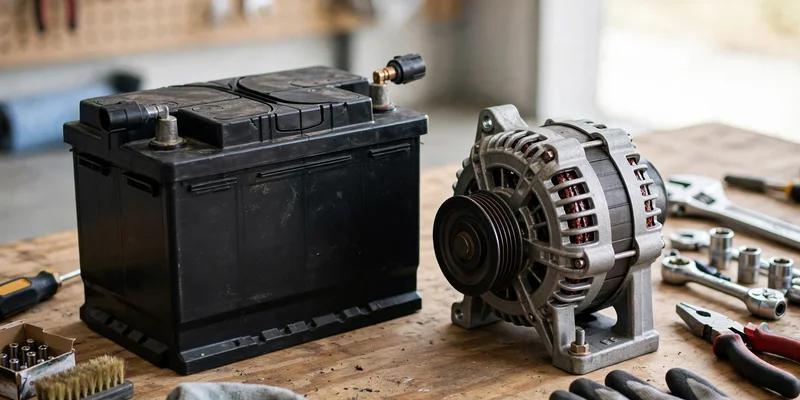
A bad alternator shows up when the car dies after a jump start or the voltage stays under 13 volts with the engine running. A bad battery shows up when the car will not start at all, yet it holds a charge after a full charge on a charger.
- Jump start, then the car dies again means the alternator is likely bad – The jump gives the battery power to start, but the alternator cannot refill it while you drive. If the car stalls within an hour of a jump, test the alternator first.
- A battery that holds a charge after charging points to the battery as the fault – Charge the battery fully with a charger, then let it sit overnight. If it still reads 12.4 volts or more in the morning, the battery is fine and the alternator is the suspect.
- Slow cranking on a cold morning points to the battery – A weak battery turns the engine over slowly, yet the car runs fine once started. A bad alternator lets the car start fine, then kills it later as the battery drains.
- Check the age of the battery before you blame the alternator – Most car batteries last 3 to 5 years. A battery older than 4 years that will not hold a charge is likely the fault, even if the alternator is also old.
- A clicking sound at startup is a different fault – Our guide to a car makes clicking noise when turning can help you tell noises apart.
Quick test you can trust
Charge the battery fully, then start the car and test the voltage at the battery. If the reading is 13.8 to 14.7 volts, the alternator works and the battery was the fault. If the reading stays under 13 volts, the alternator is bad. That one test settles most cases in under 10 minutes.
Can you drive with a bad alternator?
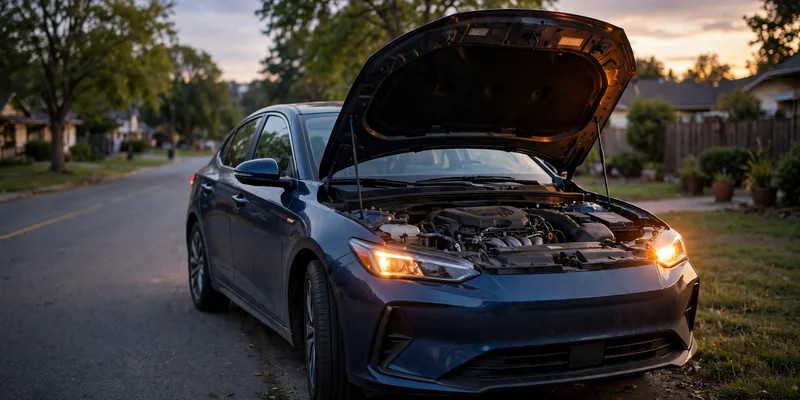
No, you should not drive far with a bad alternator. A bad alternator can stall your car without warning, since the battery drains a little more on every mile and the engine stops once the voltage gets too low.
- A short drive to the shop is usually fine – Drive under 10 miles, turn off the radio, the air conditioning, and the heated seats, and keep the headlights off in daylight. A nurse in Ohio drove hers 8 miles to the shop this way after the battery light came on.
- Do not drive at night or on a long trip – Your lights drain the battery fast, and a stall on a dark highway is a serious safety risk. Call for a tow instead of risking a long drive home.
- Stop driving if the car stalls, the lights go very dim, or the dash warning lights flash – Pull over in a safe place, turn the car off, and call for roadside help. Trying to restart a car with a dead battery can damage the starter.
- Keep a jump starter or jumper cables in the trunk – A portable jump starter can get you to the shop once, but it is not a fix. The alternator still needs to be replaced, and each jump drains the battery more.
- Check your brakes too before any short drive – Our guide on how to tell if your brake pads are worn covers a safety check you should never skip.
How do I know if my alternator is bad or my battery is bad?
A bad alternator shows a voltage under 13 volts with the engine running, and the car dies soon after a jump start. A bad battery will not hold a charge even after a full charge on a charger. Test the voltage at the battery with the engine running to tell them apart.
What voltage should a good alternator put out?
A good alternator should put out 13.8 to 14.7 volts with the engine running and the battery connected. With the lights and heater on, it should still hold 13.5 volts or more. A reading under 13 volts points to a bad alternator, a worn belt, or a wiring fault.
How long does an alternator last?
An alternator lasts 100,000 to 150,000 miles on most cars, or 7 to 10 years of normal use. Heat, oil leaks, and a worn belt can shorten that life. If your car is past 100,000 miles and the battery light comes on, a worn alternator is a likely cause.
Can a bad alternator drain a new battery?
Yes, a bad alternator can drain a new battery in a few hours of driving. The battery powers the lights and electronics, and nothing refills it while the engine runs. A new battery will not fix a charging fault, so test the alternator before you buy another battery.
What does a bad alternator sound like?
A bad alternator sounds like a high whine or a grinding noise from the front of the engine. The whine rises with engine speed and gets louder over days or weeks. A grinding sound means the bearing is close to failing, so get it checked within a day or two.
How much does it cost to replace an alternator in 2026?
Replacing an alternator costs $400 to $800 in total in the US in 2026, with the part at $200 to $500 and labor at $150 to $300. The job takes 1 to 2 hours on most cars. A dealer will charge more, often $600 to $1,000 in total for the same job.
Can you jump start a car with a bad alternator?
Yes, you can jump start a car with a bad alternator, but it will not stay running for long. The jump gives the battery enough power to start, yet the alternator cannot recharge it. Drive straight to a shop, turn off the accessories, and do not stop the engine on the way.
Will a bad alternator cause a car to stall while driving?
Yes, a bad alternator can cause a car to stall while driving. The battery drains as you drive, and once the voltage drops too low, the fuel pump and ignition lose power. If the car stalls, pull over safely, turn it off, and call for a tow.
Conclusion
So, in this article, we covered how to tell if your alternator is bad in detail. You now know the warning signs to watch for, from dim lights and a battery warning light to a whining noise and a dead battery after a jump start. You also know the home multimeter test, with 13.8 to 14.7 volts as the healthy range, and the 2026 replacement cost of $400 to $800. My advice is simple: test the voltage within a day of the battery light coming on, and do not drive far with the fault. A $400 to $800 alternator job now beats a tow bill and a dead battery on the road. If this guide helped you, share it with a friend whose car shows the same signs, and check the next guide in our Auto Parts series for your next fix.