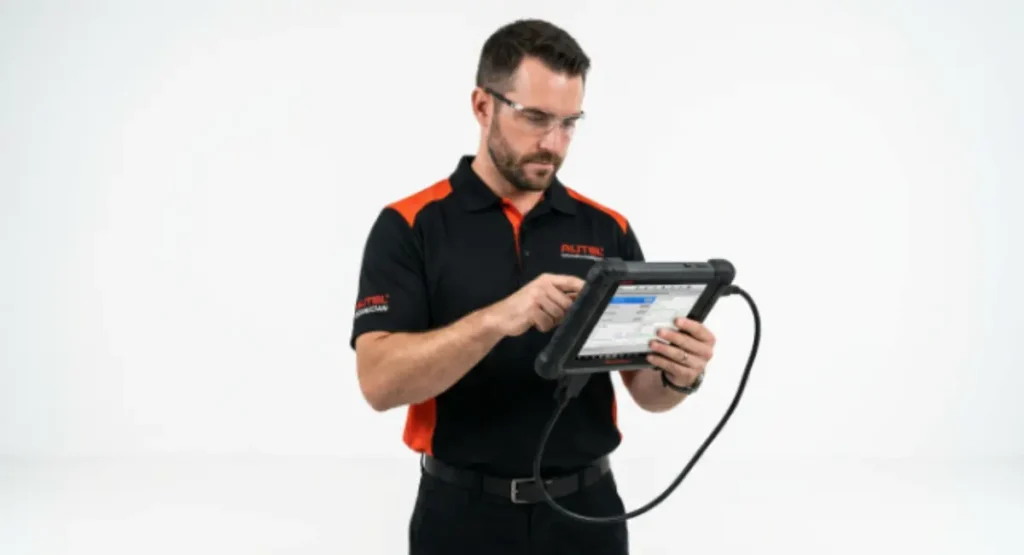
Many vehicle problems never trigger a warning light, yet they can still lead to expensive repairs. Here is the thing. An automotive oscilloscope kit lets you see electrical signals that ordinary scan tools and multimeters often miss. If you’ve ever replaced a part only to discover the fault was somewhere else, you know how frustrating that can be. Whether you’re a professional technician, a DIY enthusiast, or an automotive student, understanding live waveforms can completely change the way you diagnose vehicles.
By the end of this guide, you’ll know what an automotive oscilloscope kit does, which features matter most, how to use one safely, and how to choose the right kit for your budget and diagnostic needs.
What Is an Automotive Oscilloscope Kit?
An automotive oscilloscope kit is a diagnostic tool that displays electrical signals as live waveforms. It helps you find problems that a basic scan tool or multimeter often cannot detect.Here is the thing. Modern vehicles rely on dozens of sensors and electronic control units. When one component sends an incorrect signal, an oscilloscope lets you see the problem in real time instead of guessing.
Unlike a multimeter, which shows a single voltage reading, an oscilloscope displays how voltage changes over time. That makes it much easier to diagnose intermittent faults and hidden electrical issues.
Here Are More Helpful Information:
How does an automotive oscilloscope work?
The oscilloscope connects to a vehicle component through probes and records electrical signals thousands or even millions of times every second. Those signals appear as waveforms on the screen.
From real workshop experience, comparing a faulty waveform with a known good one often reveals the problem within minutes.
What comes inside a typical automotive oscilloscope kit?
A typical automotive oscilloscope kit includes the essential tools needed for accurate vehicle diagnostics. Most kits come with an oscilloscope unit, test probes, leads, back probing pins, clips, and diagnostic software to help you test and analyze different automotive electrical systems.
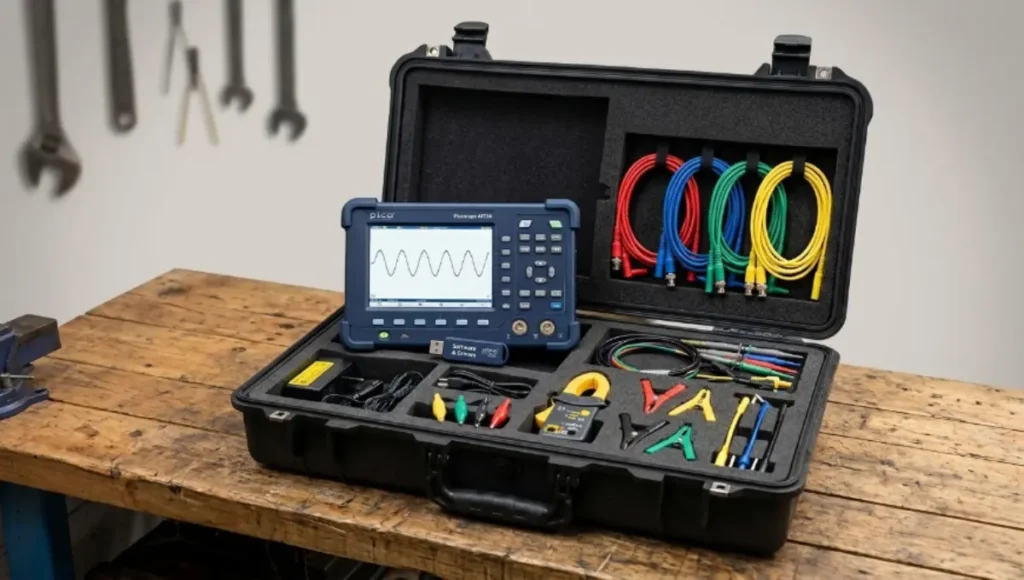
This is the main device that captures and displays electrical waveforms. Some models are handheld, while others connect to a laptop.
- Oscilloscope unit
- Test probes and leads
- Back probing pins and clips
- Software
1. Oscilloscope unit
This is the main device that captures and displays electrical waveforms. Some models are handheld, while others connect to a laptop.
2. Test probes and leads
These help you connect safely to sensors, ignition coils, injectors, batteries, and other electrical components.
3. Back probing pins and clips
They let you test wiring without cutting insulation, helping prevent damage to the vehicle’s electrical system.
4. Software
Many professional kits include software that records waveforms, stores test results, and compares signals with known good patterns.
Why is it different from a standard multimeter?
A multimeter measures voltage, resistance, and continuity at a single point in time.
An oscilloscope shows the entire electrical signal as it changes. Think about it this way. A sensor may show the correct voltage on a multimeter but still produce an unstable waveform that only an oscilloscope can reveal.
Why Should You Use an Automotive Oscilloscope Kit Instead of Basic Diagnostic Tools?
An automotive oscilloscope kit gives you a clearer picture of what is happening inside a vehicle’s electrical system. It helps you diagnose faults that ordinary diagnostic tools often miss.
The truth is, many modern vehicle problems never trigger a fault code. Without an oscilloscope, finding those issues can take hours of unnecessary testing.
Problems a multimeter cannot detect
A multimeter works well for checking battery voltage and basic circuits. It cannot display fast changing electrical signals.
For example, a fuel injector may receive power but fire inconsistently. A multimeter may show everything looks normal, while an oscilloscope clearly displays the irregular injector pulse.
Common vehicle systems you can test
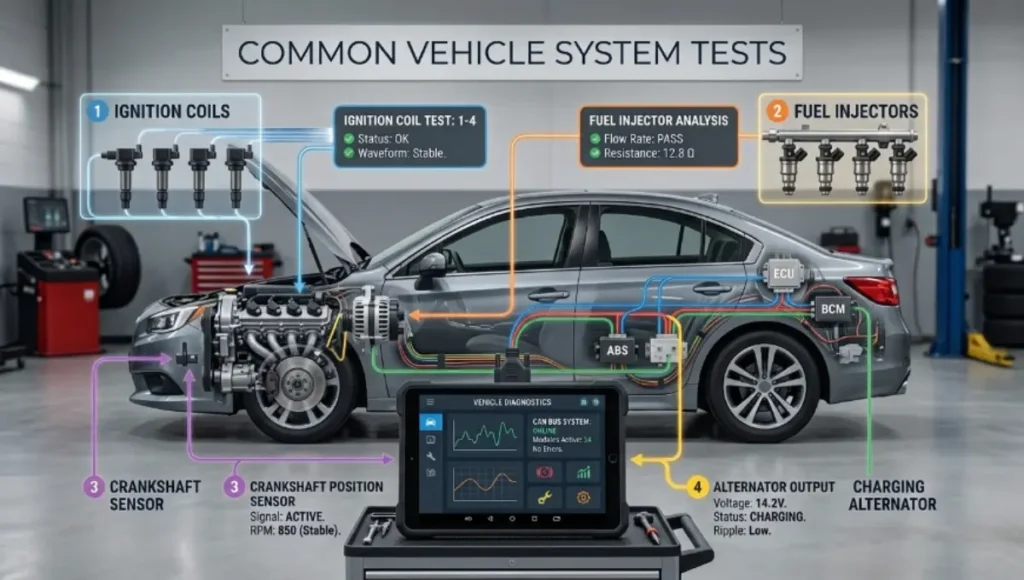
An automotive oscilloscope can help you test many important vehicle systems, including ignition, fuel, charging, sensors, and communication networks. It allows you to see real electrical signals and find hidden faults that basic diagnostic tools may miss.
- Ignition system
- Fuel injectors
- Crankshaft and camshaft sensors
- Charging system
- CAN bus network
1. Ignition system
Check ignition coil performance and spark patterns to identify weak or failing components before they cause bigger problems.
2. Fuel injectors
View injector pulse signals to detect clogged injectors, wiring faults, or inconsistent operation.
3. Crankshaft and camshaft sensors
Compare waveform patterns to identify timing issues, damaged sensors, or wiring problems.
4. Charging system
Measure alternator ripple and battery charging performance to detect faults before they leave you stranded.
5. CAN bus network
Test communication signals between vehicle modules when a scan tool cannot identify the real cause of the problem.
Real example
A repair shop received a sedan with random engine misfires. The scan tool only showed a generic misfire code.
Using an oscilloscope, the technician found one ignition coil producing an unstable waveform. Replacing that single coil fixed the issue and avoided replacing unnecessary parts.
Who Needs an Automotive Oscilloscope Kit?
Anyone who repairs, maintains, or studies modern vehicles can benefit from an automotive oscilloscope kit. It improves diagnostic accuracy and saves valuable time.
Let me explain. Vehicles built over the last decade rely heavily on electronic systems. Understanding those systems requires more than a basic scan tool.
Professional mechanics
Professional mechanics use an automotive oscilloscope kit to diagnose complex electrical problems faster and more accurately. It helps them find the real cause of faults before replacing expensive parts.
With waveform testing, mechanics can handle modern vehicle systems with more confidence and reduce unnecessary repairs.
- Faster troubleshooting
- Higher repair confidence
1. Faster troubleshooting
Accurate waveform testing helps identify faults quickly, allowing workshops to complete more repairs each day.
2. Higher repair confidence
Mechanics can verify the actual cause of a problem before replacing expensive components.
DIY car enthusiasts
DIY car enthusiasts can use an automotive oscilloscope kit to understand how vehicle systems work and diagnose problems with more confidence. It helps them avoid guesswork and reduce unnecessary part replacements.
- Better learning experience
- Lower repair costs
1. Better learning experience
You can understand how sensors and ignition systems actually work instead of relying on guesswork.
2. Lower repair costs
Finding the real fault first can save hundreds of dollars in unnecessary parts replacement.
Automotive students and EV technicians
Automotive students and EV technicians can build practical diagnostic skills by learning how to read real electrical waveforms. These skills are valuable for working with modern vehicles and electric vehicle systems.
- Build practical diagnostic skills
- Prepare for future careers
1. Build practical diagnostic skills
Students gain hands on experience reading live electrical waveforms used in professional workshops.
2. Prepare for future careers
Electric vehicles and advanced driver assistance systems depend heavily on electronic diagnostics, making oscilloscope skills increasingly valuable.
Fleet maintenance teams
Fleet maintenance teams use automotive oscilloscopes to find faults quickly and keep vehicles running efficiently. Faster diagnosis helps reduce downtime and lowers repeated repair costs.
- Reduce vehicle downtime
- Control maintenance expenses
1. Reduce vehicle downtime
Faster fault diagnosis helps delivery vans, taxis, and company vehicles return to service sooner.
2. Control maintenance expenses
Correct diagnosis the first time reduces repeat repairs and helps extend the life of important vehicle components.
What Features Should You Look for Before Buying an Automotive Oscilloscope Kit?
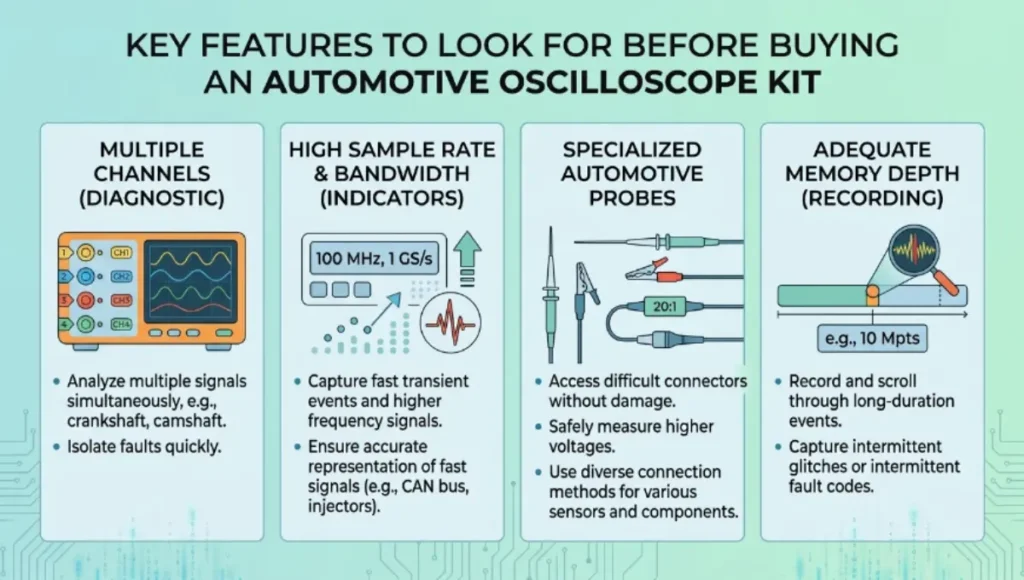
The best automotive oscilloscope kit should match your diagnostic needs, skill level, and the type of vehicles you work on. Focus on features like channels, sample rate, probes, software, and compatibility before making a decision.
The truth is, buying the most expensive kit does not always mean better results. A good kit is the one that gives you the right tools for your daily testing work.
Number of channels
The number of channels decides how many signals you can view at the same time.
- Two channel oscilloscope
- Four channel oscilloscope
1. Two channel oscilloscope
This is suitable for basic testing like comparing crankshaft and camshaft sensor signals on most vehicles.
2. Four channel oscilloscope
This gives more flexibility for advanced diagnostics, such as checking multiple sensors or communication signals together.
Bandwidth and sample rate
Bandwidth and sample rate determine how accurately the oscilloscope captures fast changing signals.
For automotive work, a higher sample rate helps you detect small signal problems in sensors, injectors, and ignition systems that happen within milliseconds.
Automotive test leads and probes
Good quality probes make testing safer and more accurate.
A professional kit should include back probes, flexible leads, and clamps that allow you to test vehicle wiring without causing damage.
Built in software and compatibility
Modern oscilloscopes often include software that helps you save and compare waveform data.
For example, a technician can compare a faulty injector signal with a known good waveform to find the issue faster.
Portability and durability
A portable oscilloscope is useful for mobile mechanics and workshops with different vehicle locations.
A strong design with a clear display helps you perform tests easily in engine bays and difficult working conditions.
How Do You Use an Automotive Oscilloscope Kit Step by Step?
Using an automotive oscilloscope kit starts with safe connections, correct settings, and proper waveform analysis. The process becomes easier when you follow a simple testing method.
Here is the thing. An oscilloscope only gives accurate results when the setup is correct.
- Prepare the vehicle safely
- Connect the probes correctly
- Select the correct settings
- Read and interpret the waveform
- Save and compare test results
1.Prepare the vehicle safely
Before testing, turn off unnecessary electrical loads and identify the correct testing point.
Always check the vehicle manual or wiring diagram before connecting probes to sensitive electronic components.
2. Connect the probes correctly
Attach the ground clip and signal probe to the correct locations.
A wrong connection can create false readings or make a healthy component appear faulty.
3. Select the correct settings
Choose the correct voltage range, time scale, and trigger settings based on the component you are testing.
For example, ignition systems usually need different settings compared with slower sensor signals.
4. Read and interpret the waveform
Look for unusual patterns, missing signals, or changes compared with a normal waveform.
A healthy sensor usually creates a predictable pattern, while a damaged sensor may show interruptions or irregular signals.
5. Save and compare test results
Saving waveform data helps you compare current results with future tests.
Many technicians keep a library of known good waveforms from different vehicle models for faster diagnosis.
What Can You Diagnose with an Automotive Oscilloscope Kit?
An automotive oscilloscope kit can diagnose problems in ignition, fuel, sensors, charging systems, and vehicle communication networks. It helps you see the actual electrical behavior behind a fault.
Many issues that appear confusing with a scan tool become easier when you can view the live waveform.
- Ignition system
- Fuel injectors
- Crankshaft and camshaft sensors
- Charging system
- CAN bus communication
1. Ignition system
An oscilloscope can test ignition coils, spark signals, and primary ignition patterns.
This helps identify weak spark performance before it causes engine misfires or poor fuel economy.
2. Fuel injectors
You can check injector pulse signals to confirm whether injectors are working correctly.
For example, an injector may receive power but have an incorrect pulse pattern due to wiring or control issues.
3. Crankshaft and camshaft sensors
These sensors create important timing signals for engine operation.
Comparing waveform patterns can help identify damaged sensors, wiring problems, or incorrect timing.
4. Charging system
An oscilloscope can measure alternator ripple and battery charging patterns.
This helps detect charging faults before they cause battery failure or electrical system problems.
5. CAN bus communication
Modern vehicles use CAN bus networks to allow control modules to communicate.
An oscilloscope can check communication signals when a scan tool cannot identify the reason behind module errors.
Which Mistakes Should You Avoid When Using an Automotive Oscilloscope Kit?
The biggest mistakes with an automotive oscilloscope kit usually come from incorrect connections, wrong settings, or poor waveform analysis. Avoiding these errors helps you get accurate results and prevents unnecessary repairs.
The truth is, even an advanced oscilloscope cannot provide useful information if it is not used correctly.
- Incorrect probe placement
- Wrong voltage range selection
- Ignoring waveform patterns
- Skipping safety precautions
1.Incorrect probe placement
Connecting probes to the wrong wire or terminal can create false readings.
Always confirm the wiring diagram before testing sensors, ignition systems, or communication circuits.
2. Wrong voltage range selection
Choosing the wrong voltage scale can hide important details in the waveform.
For example, a low voltage sensor signal may appear unclear if the oscilloscope range is set too high.
3. Ignoring waveform patterns
Many beginners only look for a signal instead of studying the complete waveform.
A small change in the shape, timing, or frequency of a waveform can reveal a failing component.
4. Skipping safety precautions
Vehicle electrical systems can contain sensitive electronic components.
Use proper grounding methods and avoid connecting probes randomly to prevent damage to control modules.
How Do You Choose the Best Automotive Oscilloscope Kit for Your Budget?
The best automotive oscilloscope kit depends on your experience, testing needs, and available budget. Choose features that match your work instead of paying for tools you may never use.
A beginner working on basic repairs needs different features compared with a professional technician handling advanced diagnostics.
- Entry level options
- Mid range kits
- Professional grade diagnostic kits
- Features worth paying for
1.Entry level options
Entry level kits are suitable for students, DIY users, and basic vehicle testing.
These models usually include 1 or 2 channels and can handle common checks like sensors, ignition signals, and simple electrical faults.
2. Mid range kits
Mid range kits offer better performance for regular automotive repair work.
They often include 4 channels, improved software, and higher sample rates for testing multiple signals at the same time.
3. Professional grade diagnostic kits
Professional kits are designed for workshops and advanced technicians.
They provide features like advanced waveform analysis, large data storage, and compatibility with complex vehicle systems.
4. Features worth paying for
Focus your budget on features that improve daily testing.
A reliable probe set, good software support, and enough channels are usually more valuable than extra features you rarely use.
What Are the Best Tips for Getting Accurate Test Results?
Accurate results depend on proper setup, clean connections, and correct waveform interpretation. A few simple habits can improve your diagnostic results significantly.
From real workshop use, experienced technicians follow a consistent testing process before making any repair decision.
- Keep probes clean
- Compare waveforms with known good patterns
- Practice on healthy vehicles first
- Update the software regularly
1.Keep probes clean
Dirty or damaged probes can create incorrect readings and confusing waveforms.
Clean connections help the oscilloscope capture the real electrical signal from the vehicle component.
2. Compare waveforms with known good patterns
A waveform becomes easier to understand when compared with a healthy example.
For example, comparing a faulty crankshaft sensor signal with a normal waveform can quickly reveal timing problems.
3. Practice on healthy vehicles first
Learning on a working vehicle helps you understand what normal signals look like.
Once you know the correct waveform pattern, finding faults in damaged systems becomes much easier.
4. Update the software regularly
Updated software can improve testing features and add support for newer vehicles.
Many professional technicians regularly update their diagnostic tools to stay compatible with modern automotive systems.
Frequently Asked Questions
An automotive oscilloscope kit helps answer many common vehicle diagnostic questions. Here are the most asked questions about choosing and using this tool.
1.Can beginners use an automotive oscilloscope kit?
Yes, beginners can use an automotive oscilloscope kit with proper learning and practice. Starting with simple tests like battery signals and basic sensors makes the learning process easier.
2. Is an automotive oscilloscope better than an OBD2 scanner?
An automotive oscilloscope and an OBD2 scanner perform different jobs. An OBD2 scanner reads fault codes, while an oscilloscope shows the actual electrical signals behind those faults.
3. How many channels do I need in an automotive oscilloscope?
For basic vehicle testing, a 2 channel oscilloscope is usually enough. Professional technicians often prefer 4 channel models for advanced testing of multiple signals at the same time.
4. Can an oscilloscope diagnose EV systems?
Yes, an oscilloscope can help test many electronic systems in electric vehicles. It is useful for checking sensors, communication signals, and low voltage control circuits.
5. How much does a good automotive oscilloscope kit cost?
The price depends on features, channels, and brand quality. Entry level kits may cost around $100 to $300, while professional models can cost over $1,000.
Conclusion
An automotive oscilloscope kit is a powerful diagnostic tool for finding electrical problems that basic tools often miss. It helps you see real signals and make better repair decisions.Whether you are a mechanic, student, DIY enthusiast, or EV technician, choosing the right kit depends on your testing needs and experience level.
A good oscilloscope does not replace your knowledge. It gives you better information so you can diagnose problems faster and avoid unnecessary part replacements.