
Electric vehicles are not the future. They are the present. And if you don’t understand what an electric vehicle is by now, you are already behind on one of the biggest shifts in transportation history.
The truth is, most people have opinions about EVs without actually understanding them. That’s a problem.
This guide fixes that. You’ll learn exactly how electric vehicles work, what types are available, how much they cost to own, and what nobody tells beginners before they buy. By the end, you’ll know more than most people who already drive one.
What is an Electric Vehicle?
Let me give you the simplest answer first. An electric vehicle is a car, truck, or bus that runs on electricity instead of gasoline or diesel. That’s it at its core.
Instead of burning fuel to create power, an EV uses electricity stored in a large battery pack. That battery powers an electric motor, which spins the wheels and moves the car.
Think about it this way. Your smartphone runs on a battery and you charge it at night. An EV works on the same basic idea, just on a much larger scale.
What Exactly is an Electric Vehicle and How is it Different?
Most people know EVs run on electricity. But very few understand what that actually changes about the car. The difference goes way deeper than just swapping fuel for a battery. It changes how the car is built, how it performs, and how much it costs to keep running over time.
1. The Simple Definition Nobody Actually Gives You
A gas car has an engine that explodes tiny amounts of fuel thousands of times per minute to generate power. It’s noisy, hot, and complicated. An EV skips all of that entirely.
There are no explosions in an electric vehicle. No exhaust pipe. No smell of burning fuel. Just quiet, instant power every time you press the accelerator.
That’s the real difference. And once you feel it, most drivers say they can’t go back.
2. EV vs Gas Car
A traditional gas car has over 2,000 moving parts in its engine and drivetrain alone. An electric motor has around 20. That gap matters more than most people realize.
Fewer moving parts means fewer things to break. No oil changes. No timing belts. No spark plugs. The mechanical complexity that makes gas cars expensive to maintain simply doesn’t exist in an EV.
In practice, EV owners typically spend 30 to 40 percent less on maintenance annually compared to gas car owners, according to Consumer Reports data.
3. How Does an Electric Motor Actually Work?
Here’s the thing. An electric motor works by using magnetism to create rotation. When electricity flows through coils of wire inside the motor, it creates a magnetic field. That field pushes against magnets and makes the motor spin.
That spinning force goes directly to the wheels. No gears shifting. No warm-up time needed. Power is available the instant you press the pedal.
That’s why a Tesla Model 3, which starts around $40,000, can go from 0 to 60 mph in just 4.2 seconds. The power delivery is immediate and smooth every single time.
What Are the Different Types of Electric Vehicles Available Today?
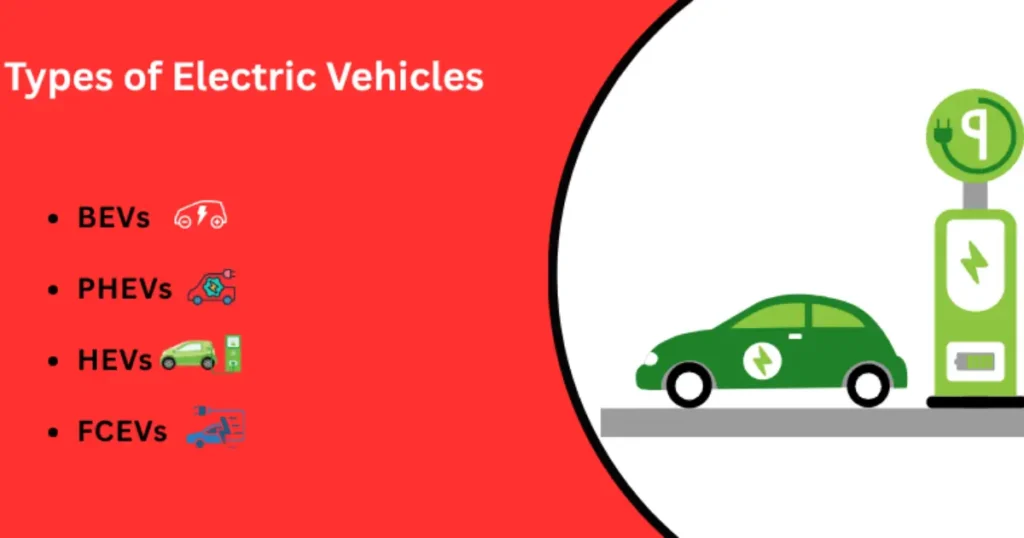
Not every electric vehicle works the same way. There are four main types and knowing the difference helps you make a smarter buying decision.
- Battery Electric Vehicles (BEVs)
- Plug-in Hybrid Electric Vehicles (PHEVs)
- Hybrid Electric Vehicles (HEVs)
- Fuel Cell Electric Vehicles (FCEVs):
1. Battery Electric Vehicles (BEVs)
A BEV runs 100 percent on electricity. There is no gas engine anywhere in the car. You charge it, you drive it, that’s the whole system.
Examples include the Tesla Model Y, Chevrolet Equinox EV, and Hyundai Ioniq 6. These are the vehicles most people picture when they hear the words “electric vehicle.”
BEVs produce zero direct emissions and have the lowest running costs of any vehicle type available right now.
2. Plug-in Hybrid Electric Vehicles (PHEVs)
A PHEV has both an electric battery and a gas engine working together. You can charge it like an EV and drive on electricity for shorter trips, typically 20 to 50 miles depending on the model.
When the battery runs low, the gas engine kicks in automatically. You never get stranded because you can always fill up at a regular gas station.
A great real-world example is the Toyota RAV4 Prime. It gives you around 42 miles of pure electric range, then switches to hybrid mode for longer highway drives.
3. Hybrid Electric Vehicles (HEVs)
A regular hybrid like the Toyota Camry Hybrid or Honda Accord Hybrid has a small electric motor that assists the gas engine. You never plug it in at all.
The battery charges itself using energy recovered during braking. This process is called regenerative braking and it happens automatically every time you slow down.
HEVs get much better fuel economy than traditional gas cars, but they are not truly electric vehicles. They still depend entirely on gasoline to run.
4. Fuel Cell Electric Vehicles (FCEVs)
An FCEV uses hydrogen gas to generate electricity on board the vehicle. It drives like a BEV but you refuel it with hydrogen in about 5 minutes instead of charging a battery over hours.
The Toyota Mirai and Hyundai Nexo are the two most well-known examples available today. They emit only water vapor from the tailpipe, nothing else.
The truth is, FCEVs are exciting technology but hydrogen refueling stations are still very limited. Right now they exist mainly in California and a few parts of Europe and Japan.
How Does an Electric Vehicle Actually Charge?
Charging an EV is honestly simpler than most people expect. You plug it in, walk away, and come back to a full battery. But there are three different levels of charging and each one works differently.
Level 1 Charging
Level 1 charging uses a standard 120-volt household outlet. The same kind you plug your laptop into. No special equipment needed at all.
The downside is speed. Level 1 adds roughly 3 to 5 miles of range per hour of charging. If you drive 30 miles a day, you need about 6 to 8 hours overnight to recover that range.
It works fine for light daily drivers. But if you drive long distances regularly, Level 1 alone will feel frustratingly slow very quickly.
Level 2 Charging
Level 2 uses a 240-volt outlet, the same type your dryer or oven uses at home. You need a special charger unit installed, called an EVSE, which typically costs $200 to $500 plus installation.
The speed difference is significant. Level 2 adds 15 to 30 miles of range per hour. Most EV owners charge overnight with Level 2 and wake up to a full battery every single morning.
Public Level 2 chargers are also available at shopping malls, parking garages, gyms, and workplaces across the USA and in most major cities worldwide.
DC Fast Charging
DC Fast Charging is the fastest option available right now. It can add 100 to 200 miles of range in just 20 to 30 minutes depending on the vehicle and charger power.
Tesla Superchargers and Electrify America stations are the most well-known fast charging networks in the USA. A 15 to 20 minute stop during a road trip coffee break is usually enough to keep going comfortably.
Not every EV supports DC Fast Charging at the same speed. The Hyundai Ioniq 6, for example, can charge at up to 350 kW, one of the fastest rates of any EV available today.
How Long Does It Really Take to Charge an EV?
The honest answer is: it depends on three things. The size of the battery, the speed of the charger, and how empty the battery is when you start.
A real example helps here. The Tesla Model Y Long Range has a 82 kWh battery. On Level 2 at home, a full charge from nearly empty takes about 8 hours. On a Tesla Supercharger, you can get 80 percent charge in around 25 minutes.
Most EV owners never actually charge from zero to 100 percent. Charging daily from 20 to 80 percent is the smarter habit. It’s faster and it keeps your battery healthier long term.
Can You Charge an EV at Home?
Yes, and most EV owners do exactly that. Around 80 percent of all EV charging in the USA happens at home, according to the US Department of Energy.
You start every morning with a full battery without ever visiting a gas station. That convenience is something most new EV owners say they never expected to love so much.
If you live in an apartment without a dedicated parking spot, home charging gets trickier. But more apartment buildings and workplaces are adding chargers every year to close that gap.
How Does an Electric Vehicle Work?
Here’s the simple version. You charge the battery. The battery sends electricity to the motor. The motor spins the wheels. You drive.
There are no explosions, no exhaust, and no complicated engine management system working behind the scenes. The whole process is cleaner and more direct than anything a gas car does.
Let me explain the key steps in order so it all makes sense.
Step 1: The Battery Stores the Energy
The battery pack in an EV is large, flat, and sits underneath the floor of the car. This is called the skateboard platform and it keeps the center of gravity low for better handling.
Modern EV batteries are measured in kilowatt-hours, or kWh. A bigger number means more energy stored and more range available. The Tesla Model 3 Standard Range uses a 60 kWh battery. The Rivian R1T truck uses a 135 kWh battery.
The battery is made up of thousands of small lithium-ion cells, similar to the ones in your phone but grouped together in a much larger and more powerful pack.
Step 2: The Inverter Converts the Power
The battery stores electricity as DC power, which stands for direct current. But the electric motor needs AC power, which stands for alternating current, to run properly.
The inverter sits between the battery and the motor. It converts DC to AC automatically every time you drive. You never think about it. It just happens instantly in the background.
This conversion process is highly efficient. EV motors convert about 85 to 91 percent of electrical energy into actual movement. A gas engine typically converts only 20 to 40 percent of fuel energy into movement. The rest is lost as heat.
Step 3: The Motor Delivers Instant Power
The electric motor takes that AC power and uses it to create rotation through electromagnetism. That rotation goes straight to the wheels with almost no delay at all.
This is why EVs feel so quick off the line. There’s no revving up, no gear changes, no turbo lag. You press the pedal and the power is just there immediately.
A Rivian R1T electric truck produces 835 horsepower and 908 lb-ft of torque. It does 0 to 60 mph in 3 seconds. That is faster than most sports cars and it weighs over 7,000 pounds.
Step 4: Regenerative Braking Recovers Energy
Every time you lift your foot off the accelerator or press the brake, the motor reverses its job. It becomes a generator and converts your car’s movement back into electricity.
That electricity goes back into the battery. It’s not a huge amount on any single stop, but across a full day of driving it adds up. Regenerative braking can recover 10 to 25 percent of energy depending on how you drive.
In city driving with lots of stop and go traffic, regenerative braking actually makes EVs more efficient than on the highway. That’s the opposite of how gas cars work.
Parts of an Electric Vehicle
An EV has far fewer parts than a gas car. But the parts it does have are worth understanding. Here are the key components that make everything work:
- Battery Pack
- Electric Motor
- Inverter
- Onboard Charger
- DC to DC Converter
1. Battery Pack
The battery pack is the most important and most expensive part of any EV. It stores all the energy the car needs to move and powers every system on board.
Most EV batteries today use lithium-ion chemistry, the same technology as your phone but on a much larger scale. A replacement battery pack can cost between $5,000 and $20,000 depending on the vehicle, which is why battery health matters so much.
2. Electric Motor
The electric motor converts electrical energy into mechanical rotation to move the wheels. Some EVs have one motor, others have two or even four for all-wheel drive and better performance.
The Rivian R1S SUV uses four individual motors, one at each wheel. This gives it extraordinary grip and control on off-road terrain where a traditional SUV would struggle badly.
3. Inverter
The inverter converts DC electricity from the battery into AC electricity for the motor. It also manages the flow of electricity during regenerative braking when energy moves in the opposite direction.
Without the inverter, the battery and motor cannot communicate properly. It’s one of the most critical electronic components in the entire vehicle.
4. Onboard Charger
The onboard charger manages the flow of electricity coming from Level 1 and Level 2 chargers into the battery pack. It controls the rate of charge to protect battery health.
Different EVs have different onboard charger capacities. A higher capacity means faster Level 2 charging at home. The Ford F-150 Lightning has an 11.5 kW onboard charger, which is on the higher end for home charging speed.
5. DC to DC Converter
The main battery operates at high voltage, often between 400 and 800 volts. But the car’s lights, screens, and accessories run on 12 volts.
The DC to DC converter steps the high voltage down to 12 volts to power all those smaller systems. Think of it as a translator between the high-power world of the drive system and the low-power world of everything else in the car.
6. Thermal Management System
Batteries are sensitive to temperature. Too cold and they lose range. Too hot and they degrade faster. The thermal management system keeps the battery at the right temperature at all times.
The Chevrolet Bolt EV uses a liquid cooling system to manage battery temperature. Proper thermal management is a big reason why some EVs age better than others over years of daily use.
Key Features of an Electric Vehicle
EVs come packed with features that gas cars simply cannot offer. Here are the ones that actually matter in daily life:
1. Instant Torque and Smooth Acceleration
Electric motors deliver their full torque from a complete standstill. You don’t wait for the engine to build up power. It’s all there the moment you touch the pedal.
This makes merging onto highways, overtaking slow vehicles, and navigating busy city traffic feel effortless. Even a modest EV like the Nissan Leaf feels quicker in everyday driving than most mid-size gas sedans.
2. Regenerative Braking
Regenerative braking slows the car and sends energy back to the battery at the same time. It reduces wear on your brake pads significantly over time.
Many EV drivers use one-pedal driving mode, where lifting off the accelerator slows the car enough that you rarely need the brake pedal at all. Brake pads on EVs often last well over 100,000 miles as a result.
3. Over-the-Air Software Updates
Tesla pioneered this feature and now most major EV brands offer it. Your car can receive new features, performance improvements, and bug fixes wirelessly overnight while you sleep.
This means your EV can actually get better over time after you buy it. Tesla has used OTA updates to increase range, improve autopilot, and even add new driving modes without the owner visiting a dealership once.
4. Large Touchscreen and Digital Controls
Most modern EVs use large central touchscreens to control navigation, climate, music, and vehicle settings. The Rivian R1T has a 15.6-inch touchscreen. The Mercedes EQS has a massive 56-inch curved screen spanning the entire dashboard.
Physical buttons are becoming rare in EVs. Some drivers love the clean look. Others find the learning curve frustrating at first. It’s worth spending time with the interface during a test drive before you commit.
5. Advanced Driver Assistance Systems (ADAS)
Most EVs come standard with features like automatic emergency braking, lane-keeping assist, and adaptive cruise control. These are often optional expensive extras on gas cars.
Tesla’s Full Self-Driving package, Ford’s BlueCruise, and GM’s Super Cruise offer hands-free highway driving on mapped roads. These systems are improving rapidly with every software update.
How to Maintain an Electric Vehicle
Here’s one of the biggest surprises for new EV owners. Maintenance is dramatically simpler and cheaper than a gas car. There’s no oil to change, no timing belt to replace, and no exhaust system to worry about.
What You Still Need to Maintain
Just because EVs are simpler doesn’t mean they’re maintenance-free. A few things still need regular attention:
1. Tires
EV tires wear faster than gas car tires because of the extra vehicle weight and the instant torque delivery. You should rotate your tires every 6,000 to 7,500 miles and check pressure monthly.
Good tire maintenance on an EV also protects your range. Underinflated tires can reduce efficiency by 5 to 10 percent, which directly cuts into how far you can drive on a single charge.
2. Brake Fluid
Even though regenerative braking reduces how often you use your physical brakes, brake fluid still absorbs moisture over time. Most manufacturers recommend replacing it every 2 years regardless of mileage.
Skipping brake fluid changes is a small thing that can lead to bigger brake system problems down the road. It’s a simple and inexpensive service that’s worth staying on top of.
3. Cabin Air Filter
The cabin air filter keeps the air inside your car clean. It needs replacing every 15,000 to 25,000 miles depending on the manufacturer’s recommendation and your local air quality.
This is actually a DIY job on many EV models. A replacement filter costs $15 to $40 and takes about 10 minutes to swap out on most vehicles.
4. Battery Cooling System
The thermal management system uses coolant to regulate battery temperature. Most manufacturers recommend inspecting the coolant level every 4 to 5 years and replacing it around the 150,000 mile mark.
Neglecting the cooling system is one of the few maintenance mistakes that can genuinely shorten your battery life. It’s inexpensive to service and absolutely worth doing on schedule.
What You Never Have to Do
This list is one of the best arguments for switching to an EV:
1. No Oil Changes
Gas cars need an oil change every 3,000 to 7,500 miles. That’s a cost of $50 to $150 each time, adding up to thousands of dollars over a car’s lifetime. EVs have no engine oil. This expense simply disappears entirely.
2. No Spark Plugs or Timing Belt
These are two of the most common and expensive gas car repairs. A timing belt replacement can cost $500 to $1,000. Spark plugs need replacing every 30,000 to 100,000 miles. EVs need neither, ever.
3. No Transmission Service
Most EVs use a single-speed fixed gear setup. There is no traditional transmission to service, flush, or replace. One more significant cost that just doesn’t exist for EV owners.
How Far Can an Electric Vehicle Go on One Charge?
Most modern EVs can travel between 200 and 350 miles on a single full charge. That’s enough for the vast majority of daily driving needs without any range anxiety at all.
What is EV Range and Why Does It Vary?
EV range is affected by several real-world factors that are worth understanding before you buy:
1. Temperature
Cold weather is hard on lithium-ion batteries. At 20 degrees Fahrenheit, some EVs lose up to 40 percent of their rated range. The Nissan Leaf is particularly sensitive to cold because it uses passive air cooling instead of liquid cooling.
Warm weather has a smaller effect but running the air conditioning on hot days does reduce range. Planning for a 10 to 15 percent range reduction in summer heat is a reasonable rule of thumb.
2. Driving Speed
Highway driving at 75 to 80 mph uses significantly more energy than city driving at 35 to 45 mph. Aerodynamic drag increases with speed and the battery works harder to maintain pace.
The EPA range figure for most EVs is calculated at a mix of city and highway speeds. Real-world highway-only range is often 10 to 20 percent lower than the official number on the sticker.
3. Real-World Range vs EPA Range: What’s the Difference?
The EPA range rating is tested under controlled laboratory conditions. Real world driving involves hills, wind, passengers, luggage, heat or AC use, and higher speeds. All of these reduce range below the EPA number.
A good rule of thumb is to expect about 80 to 85 percent of the EPA rated range in normal everyday driving. If an EV is rated at 300 miles, plan on roughly 240 to 255 miles in real use.
Which EVs Have the Longest Range
Here are the top range leaders available right now:
1. Mercedes EQS 450 Plus
The Mercedes EQS leads the pack with an EPA-rated range of up to 350 miles on a single charge. It’s a luxury sedan with a massive 107.8 kWh battery and a price tag starting around $104,000.
For buyers who want maximum range and premium comfort without compromise, the EQS is the benchmark that every other long-range EV is measured against right now.
2. Tesla Model S Long Range
The Tesla Model S Long Range offers an EPA-rated 405 miles of range, making it one of the longest-range EVs ever built. It starts at around $74,990 and combines performance with efficiency in a way few vehicles can match.
Real-world owners regularly report hitting 370 to 390 miles in mixed driving conditions. That kind of range makes even cross-country road trips feel manageable with smart charging stop planning.
3. Lucid Air Grand Touring
The Lucid Air holds the record for the highest EPA-rated range of any EV at 516 miles. Starting at around $138,000, it’s not for everyone’s budget but proves what the technology is truly capable of.
Lucid achieved this through exceptional aerodynamic efficiency and a highly optimized powertrain. It’s a technical achievement that pushed the entire EV industry to think differently about range.
How Much Does an Electric Vehicle Cost to Own?
The sticker price of an EV is often higher than a comparable gas car. But the total cost of ownership over 5 to 7 years tells a very different story.
1. Purchase Price vs Long-Term Savings
The average new EV in the USA costs around $55,000 to $65,000 in 2026. That’s above the average new car price of around $48,000. But that gap narrows fast once you factor in fuel and maintenance savings.
A typical gas car owner spends $2,000 to $3,000 per year on fuel alone. An EV owner charging mostly at home spends $500 to $800 per year on electricity for the same amount of driving. That’s a saving of $1,200 to $2,200 every single year.
2. What Does It Cost to Charge vs Fill Up with Gas?
Let’s use a real example. Driving 15,000 miles per year in a gas car that gets 30 mpg at $3.50 per gallon costs around $1,750 per year in fuel.
Driving the same 15,000 miles in an EV that uses 3.5 miles per kWh, charged at the US average electricity rate of $0.16 per kWh, costs about $686 per year. That’s over $1,000 in annual savings just on energy alone.
3. Federal Tax Credits and Incentives You Should Know About
The US federal government currently offers up to $7,500 in tax credits for new EV purchases under the Inflation Reduction Act. Income limits and vehicle price caps apply, so not everyone qualifies for the full amount.
Used EVs also qualify for a credit of up to $4,000. Many US states offer additional rebates on top of the federal credit. California, for example, offers up to $7,500 in additional state incentives through its Clean Vehicle Rebate Project.
What Are the Real Benefits of Driving an Electric Vehicle?
The benefits of driving an EV go well beyond just saving money on gas. Once you experience daily EV ownership, several advantages stand out as genuinely life-changing.
1. Environmental Impact
A battery electric vehicle produces zero direct tailpipe emissions. Over its full lifetime including manufacturing and electricity generation, an EV produces roughly 50 to 70 percent fewer carbon emissions than a comparable gas car according to the Union of Concerned Scientists.
Even in states where electricity comes mostly from coal, EVs produce less total carbon than gas cars. And as the electrical grid gets cleaner every year, every EV on the road automatically gets cleaner too without any changes to the car itself.
2. Performance and Driving Feel
The truth is, most people are completely surprised by how fun an EV is to drive. The instant torque makes every merge, every overtake, and every green light feel effortless and confidence-inspiring.
There’s also a quietness to EV driving that’s hard to describe until you experience it. No engine rumble, no gear hunting, no vibration at idle. It feels premium even in affordable models like the $28,000 Chevrolet Equinox EV.
3. Lower Maintenance
Consumer Reports found that EV owners spend about 40 percent less on maintenance and repairs compared to gas car owners over the life of the vehicle. No oil changes, no transmission service, no exhaust repairs.
In practice, the main things EV owners spend money on are tires, brake fluid, and the occasional cabin air filter. That’s genuinely it for most drivers across the first 100,000 miles of ownership.
What Are the Honest Downsides of Electric Vehicles?
EVs are not perfect. Knowing the real drawbacks before you buy is just as important as knowing the benefits. Here’s what nobody in the showroom will volunteer to tell you.
1. Range Anxiety
Range anxiety, the fear of running out of charge before reaching your destination, has gotten much better but hasn’t disappeared completely. Most modern EVs now offer 250 to 350 miles of range, which covers the vast majority of daily driving.
The anxiety tends to resurface on long road trips in areas where charging infrastructure is still sparse. Rural stretches of the Midwest and parts of the Southeast USA still have significant gaps between fast chargers. Planning your route in advance using apps like PlugShare or ABRP is essential until the network fills in.
2. Charging Infrastructure
The US has over 60,000 public charging stations as of 2026. That sounds like a lot until you compare it to over 145,000 gas stations across the country. The gap is real and it matters in certain situations.
Fast chargers are still concentrated in urban areas and along major interstate corridors. If you live in a dense city and charge mostly at home, infrastructure is rarely a problem. If you live rurally without home charging access, the current network can feel genuinely inadequate for your needs.
3. Upfront Cost and Affordability Challenges
The upfront price of most EVs is still higher than comparable gas cars. Even with the $7,500 federal tax credit, a base Tesla Model 3 still costs around $34,000 after incentives. A comparable Toyota Camry starts at $27,000 with no credits needed.
The used EV market is growing and prices are dropping, but affordable options under $25,000 remain limited in 2026. This is the single biggest barrier keeping many buyers, especially students and young first-time car buyers, from making the switch right now.
Tips for Someone Buying Their First Electric Vehicle
Buying your first EV is exciting but it’s different enough from buying a gas car that a few specific tips can save you real money and real frustration.
Questions to Ask Before You Buy
Before you sign anything, make sure you have clear answers to these questions:
What is the real-world range, not just the EPA number?
Ask the dealer or check owner forums for real-world range reports in your climate and driving conditions. Cold weather buyers in Minnesota need to think very differently about range than buyers in Arizona.
Owner communities on Reddit, like r/electricvehicles, are genuinely one of the best sources of honest real-world range data from people who actually drive the car daily in conditions similar to yours.
Does your home setup support charging?
Find out if your home has a 240-volt outlet available for Level 2 charging or if you need an electrician to install one. The average installation cost is $200 to $800 depending on your panel setup and how far the outlet is from your parking spot.
If you rent, check your lease and talk to your landlord before buying. Many states now have laws requiring landlords to allow EV charger installation, but the rules vary by location.
What to Check During a Test Drive
A test drive for an EV should cover more than just how it feels on a smooth road. Here’s what to pay attention to specifically:
One-pedal driving comfort
Try the maximum regenerative braking setting and see how it feels. Some drivers love the aggressive slowdown when lifting off the pedal. Others find it jarring at first. It takes about a week to adapt but knowing your preference before buying helps you choose the right model.
Bring your regular driving route into the test drive if you can. Getting a feel for the car in real traffic, on your actual roads, at your actual speeds gives you far more useful information than a quick spin around the block outside the dealership.
How to Pick the Right EV for Your Lifestyle
The best EV for you depends on three things above everything else. How far you drive daily, where you can charge, and what your budget actually is.
If you drive under 50 miles a day and can charge at home, almost any modern EV works perfectly for your needs. If you regularly drive 200-plus miles in a day or travel frequently through rural areas, you need a longer-range model with strong fast-charging speeds.
A practical starting point is the Chevrolet Equinox EV at around $35,000, the Hyundai Ioniq 6 starting at $38,000, or a used Tesla Model 3 which you can find for $25,000 to $30,000 in the current used market. All three are strong, well-supported choices for first-time EV buyers in 2026.
Frequently Asked Questions About Electric Vehicles
You’ve read through the full guide. But chances are, a few specific questions are still sitting in the back of your mind. That’s completely normal. EVs are a big topic and no single article covers every angle perfectly. Here are the most common questions real people search on Google after learning about electric vehicles for the first time.
What is an electric vehicle in simple terms?
Most EV batteries are designed to last 10 to 20 years or 100,000 to 200,000 miles. Most manufacturers offer an 8-year, 100,000-mile battery warranty. In practice, batteries lose about 2 to 3 percent of capacity per year. A Tesla Model 3 battery at 150,000 miles typically retains around 85 to 90 percent of its original capacity.
How much does it cost to charge an electric vehicle at home?
Charging at home costs roughly $0.16 per kWh on the US average electricity rate. A full charge on a Tesla Model 3 with a 60 kWh battery costs about $9.60. That covers around 270 miles of driving. Compared to filling a gas tank, most EV owners save $1,000 to $1,500 per year on fuel.
Can an electric vehicle work in cold weather?
Yes, but cold weather reduces battery range noticeably. At 20 degrees Fahrenheit, some EVs lose up to 40 percent of their normal range. Preconditioning your battery while still plugged in before driving helps significantly. Models with liquid-cooled battery systems like the Tesla Model Y handle cold weather much better than air-cooled models like the older Nissan Leaf.
What happens if an electric vehicle runs out of charge on the road?
The same thing that happens when a gas car runs out of fuel. You stop and call for help. Most EVs give you clear low-battery warnings with plenty of time to find a charger. Roadside assistance services like AAA now carry mobile charging units that can give you enough juice to reach the nearest charging station safely.
Is an electric vehicle cheaper to maintain than a gas car?
Yes, significantly cheaper. EVs have no oil changes, no timing belts, no spark plugs, and no exhaust system to service. Consumer Reports data shows EV owners spend about 40 percent less on maintenance than gas car owners over the life of the vehicle. The main ongoing costs are tires, brake fluid, and cabin air filters.
Which electric vehicle has the longest range in today?
The Lucid Air holds the record with an EPA-rated range of 516 miles on a single charge. For more affordable options, the Tesla Model S Long Range offers up to 405 miles and the Mercedes EQS reaches 350 miles. Most everyday EVs like the Tesla Model 3 and Hyundai Ioniq 6 offer between 270 and 360 miles of real-world range.
Do electric vehicles really help the environment?
Yes, meaningfully. Over its full lifetime, an electric vehicle produces 50 to 70 percent fewer carbon emissions than a gas car, even accounting for battery manufacturing. As the electrical grid gets cleaner each year, every EV on the road automatically becomes greener without any changes to the vehicle itself.
How long does it take to charge an electric vehicle?
It depends on the charger type. A standard home Level 1 outlet adds 3 to 5 miles of range per hour. A Level 2 home charger adds 15 to 30 miles per hour. A DC fast charger can add 100 to 200 miles in just 20 to 30 minutes. Most owners charge overnight at home and start every morning with a full battery.
What is the cheapest electric vehicle you can buy in today?
The Chevrolet Equinox EV starts at around $35,000 before incentives, making it one of the most affordable new EVs in the USA right now. After the $7,500 federal tax credit, the effective price drops to around $27,500. In the used market, you can find a Nissan Leaf or older Chevrolet Bolt for under $15,000 in good condition.
Conclusion
So, in this article, we covered what is an electric vehicle in detail. From how they work and what they cost, to charging, maintenance, range, and what to check before you buy. You now know more about EVs than most people who already drive one.
Here’s my genuine opinion. If you drive under 50 miles a day and can charge at home, there has never been a better time to make the switch. The savings are real and the driving experience is genuinely better.
Now I want to hear from you. Are you thinking about buying your first EV or still on the fence? Drop your question or thought in the comments below. I read every single one.