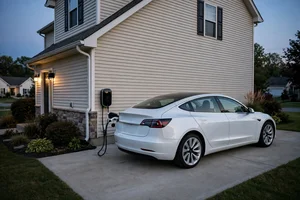
You can charge an electric car at home without a garage with a weatherproof outdoor outlet, a wall mounted Level 2 charger, or a portable Level 1 cable from a standard outlet. Most US drivers add 25 to 30 miles of range per hour with Level 2, and 3 to 5 miles per hour with Level 1. A licensed electrician can set up a charge point in one day.
No garage does not mean no home charging. Millions of US drivers park in a driveway, a carport, or on the street, and they still charge at home every night. The key is a weatherproof setup, a cable path that stays clear, and a charge speed that fits your daily miles. In this guide you will learn how to charge an electric car at home without a garage, what each option costs in 2026, how to stay safe in rain and snow, and when public charging makes more sense as a backup. You will also see how public fast charging fits in as a backup, so a street parker or a renter can still drive an EV with no home garage at all.
Can you charge an electric car at home without a garage?
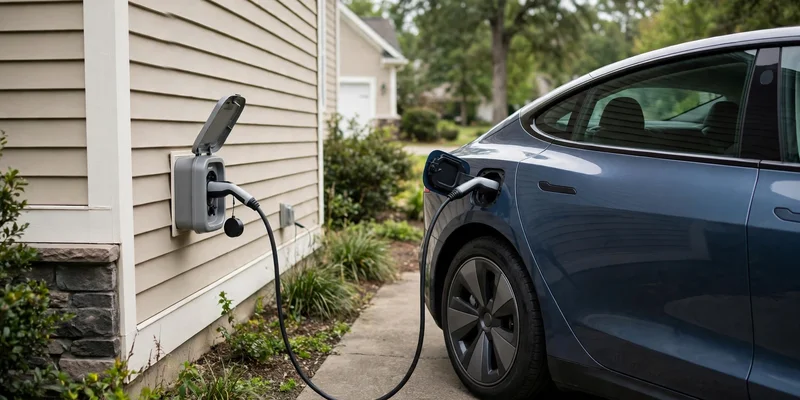
Yes, you can charge an electric car at home without a garage.
EV chargers are built for outdoor use, and most home units carry a NEMA 3R or NEMA 4 rating for rain and dust. Read how long it takes to charge an electric car at home to see how speed changes with each level.
- Outdoor Level 2 charger: 25 to 30 miles per hour. A wall mounted 240 volt unit adds about 200 miles in 8 hours overnight. A 2023 Tesla Model 3 in Austin adds 28 miles per hour on a 40 amp circuit.
- Outdoor 240 volt outlet: same speed, lower cost. A NEMA 14-50 outlet lets you plug in a portable Level 2 cable. It costs less than a fixed unit, and you can take the cable with you on trips.
A real example from a driveway in Ohio
Maria in Columbus, Ohio, has no garage and parks in a 20 foot driveway.
Can you use a regular outlet to charge an electric car outside?
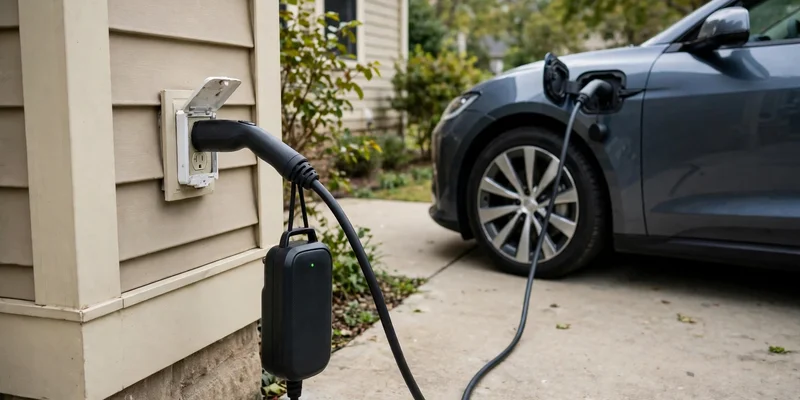
Yes, you can use a regular outlet to charge an electric car outside, as long as the outlet is a grounded GFCI outlet in a weatherproof cover.
Level 1 is the slowest option, but it is also the cheapest to start. Our guide to charging an electric car with a regular outlet covers cord length, outlet age, and fire risk in more depth.
- Speed: 3 to 5 miles per hour. A 2023 Nissan Leaf adds about 40 miles in 10 hours overnight. A driver in Miami who drives 30 miles a day can top up each night with no Level 2 unit at all.
- Outlet: GFCI and weatherproof cover. A GFCI outlet trips in a fault, and a bubble cover keeps rain off the plug. An electrician can swap a plain outdoor outlet for a GFCI one for $150 to $300.
A real example from a carport in Texas
James in Houston drives 28 miles a day in his 2021 Hyundai Kona Electric.
How do you install an outdoor Level 2 charger?
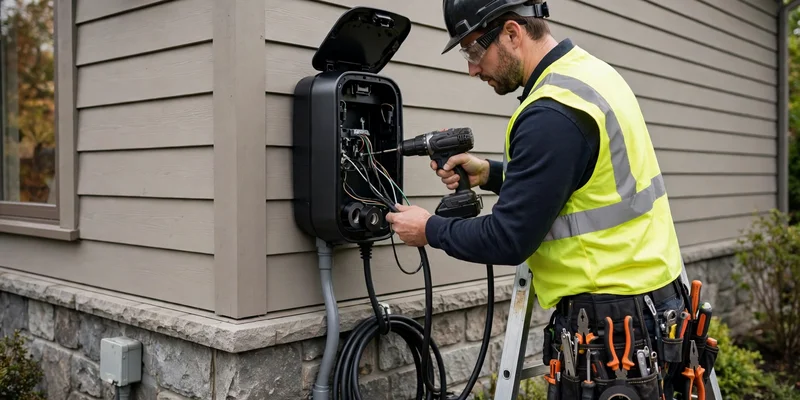
You install an outdoor Level 2 charger by hiring a licensed electrician to fit a 240 volt circuit, a weatherproof mount, and a hardwired unit or a NEMA 14-50 outlet on the house wall near your parking spot.
Start with your panel.
- Cost: $800 to $2,000 for most homes. A charger unit costs $400 to $700, and install labor costs $400 to $1,300. A 2024 Ford Mustang Mach-E owner in Denver paid $1,450 in total, with a $550 charger and $900 in labor.
- Time: 3 to 6 hours for most installs. A short run from the panel to the driveway takes half a day. A long run through a yard or under a driveway can take a full day and cost $500 more.
A real example from a panel upgrade
Priya in Seattle had a 100 amp panel and a 60 foot run to her driveway.
What are the best public charging options near home?
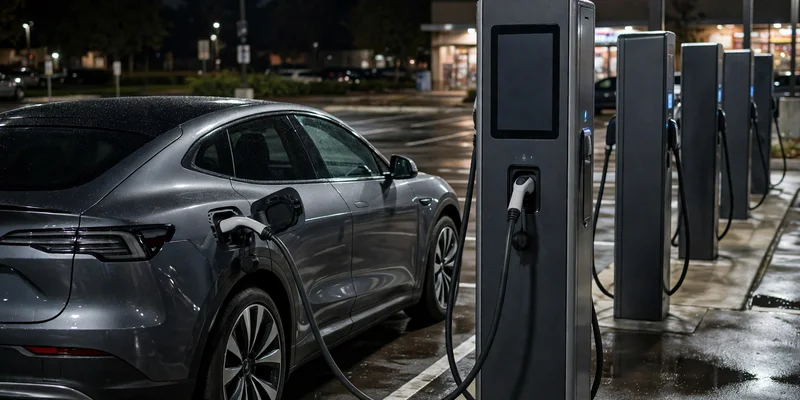
The best public charging options near home are DC fast chargers for a quick top up, Level 2 chargers at work or shops for slow top ups, and Tesla Superchargers where your car can use them.
Public charging costs more than home charging, often $0.35 to $0.50 per kWh at DC fast chargers, against $0.13 to $0.17 per kWh at home in most US states. How much it costs to charge an electric car at home per month shows the home cost side in clear US numbers.
- DC fast charging: 100 to 150 miles in 20 minutes. A 2023 Hyundai Ioniq 5 adds about 140 miles in 18 minutes on a 150 kW charger. Use it for road trips and busy weeks, not every day, since fast charging can wear the battery faster.
- Workplace Level 2: free or cheap top ups. Many US employers offer free or $0.15 per kWh charging. A driver in Chicago adds 60 miles during an 8 hour workday and charges at home only twice a week.
A real example from a street parker in New York
Alex in Brooklyn has no driveway and parks on the street.
How do you keep outdoor charging safe in rain and snow?
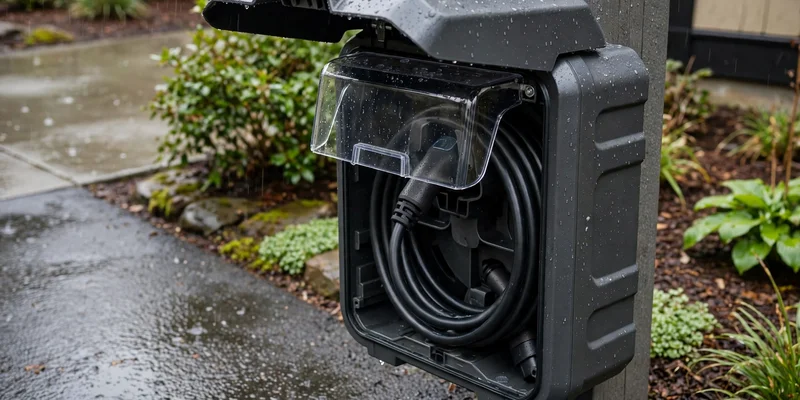
You keep outdoor charging safe in rain and snow with a weatherproof charger, a sealed charge port, a GFCI circuit, and a cable that stays off wet ground.
Rain alone does not stop charging. Cold also cuts range, so read do electric cars lose range in winter before your first cold season.
- Charger rating: NEMA 3R or NEMA 4. A NEMA 4 unit resists wind driven rain and snow. A 2023 ChargePoint Home Flex carries a NEMA 3R rating, and an Emporia unit carries NEMA 4, so both suit outdoor walls.
- Cable: hang it, do not leave it in a puddle. A wall holster costs $20 to $40 and keeps the cable off the ground. A cable left in snow can freeze to the driveway and crack when you pull it free.
A real example from a snowy winter in Minnesota
Emma in Minneapolis charges her 2022 Volkswagen ID.4 in a driveway through winters near 10 degrees Fahrenheit.
How much does it cost to charge an electric car at home without a garage?
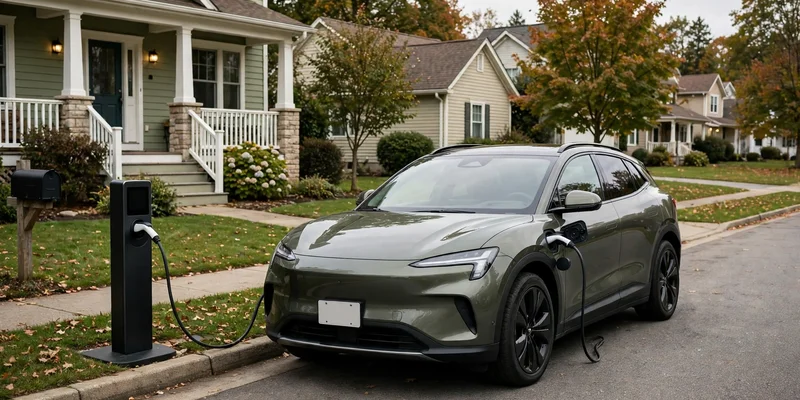
It costs $30 to $70 per month to charge an electric car at home without a garage for most US drivers, based on 1,000 miles a month and home rates of $0.13 to $0.17 per kWh.
Level 1 costs almost nothing to start, while Level 2 costs $800 to $2,000 to install. See electric car vs gas car cost per month for a full side by side. Battery life also matters for long term cost, and how long electric car batteries last puts most packs at 10 to 20 years. The federal $7,500 new EV tax credit ended for cars acquired after 30 Sept 2025, so price your next car without it, as our electric car tax credit 2026 USA guide notes. If you are shopping on a budget, the best electric cars under $30,000 list can help you pick a car that fits a home charge setup.
- Level 1 monthly cost: $30 to $50. A driver who uses 250 kWh a month at $0.15 per kWh pays $37.50. A 2021 Chevrolet Bolt owner in Ohio pays $42 a month for 900 miles.
- Level 2 monthly cost: $30 to $70. The same miles cost the same per kWh, but Level 2 lets you charge at night on a time of use rate near $0.10 per kWh in some states.
A real example from a monthly bill in California
David in San Diego drives 1,200 miles a month in his 2023 Tesla Model 3.
Frequently Asked Questions
Can I charge an electric car at home without a garage?
Yes, you can charge an electric car at home without a garage with an outdoor Level 2 charger, a weatherproof 240 volt outlet, or a standard 120 volt outlet. Most drivers use a wall mounted charger on the house and park in the driveway. The setup is safe in rain when it uses a GFCI circuit.
Is it safe to charge an electric car outside in the rain?
Yes, it is safe to charge an electric car outside in the rain. The charge port seals when the cable locks in, the car checks the link before power flows, and a GFCI circuit trips on a fault. Use a weatherproof charger rated NEMA 3R or NEMA 4, and keep the cable off standing water.
How fast can I charge an electric car at home without a garage?
You can add 25 to 30 miles of range per hour with an outdoor Level 2 charger, and 3 to 5 miles per hour with a standard 120 volt outlet. Level 2 adds about 200 miles overnight in 8 hours, while Level 1 adds about 40 miles in the same time.
How much does an outdoor EV charger install cost in 2026?
An outdoor EV charger install costs $800 to $2,000 for most US homes in 2026, with the unit at $400 to $700 and labor at $400 to $1,300. A long cable run or a panel upgrade to 200 amps can add $1,000 to $2,200. Get three quotes from licensed electricians.
Can I charge my electric car with an extension cord outside?
You can charge with an extension cord outside only if the cord is outdoor rated, heavy gauge, and as short as possible. A thin indoor cord can overheat and cause a fire. Use a 12 gauge outdoor cord under 25 feet, or fit a closer outlet instead.
Do I need a permit to install an outdoor EV charger?
Most US cities ask for an electrical permit for a new 240 volt circuit, which costs $50 to $200. A Level 1 outlet swap often needs no permit. Your electrician can pull the permit, and a city inspector signs off after the install is done.
Can I charge an electric car on the street in front of my house?
You can charge on the street in some US cities with a curbside charger or a permit for a cable cover, but many cities ban cables across a sidewalk. Check your city rules first. Public DC fast chargers and workplace chargers are the main backup for street parkers.
Does charging outside in winter hurt an electric car battery?
Charging outside in winter does not hurt the battery, but cold slows charging and cuts range by 20 to 40 percent at 20 degrees Fahrenheit. Precondition the car while it is plugged in, and keep the charge between 20 and 80 percent for daily use. Snow on the port needs a quick brush off.
Conclusion
So, in this article, we covered how to charge an electric car at home without a garage in detail. You now know Level 1 adds 3 to 5 miles per hour from a standard outlet, Level 2 adds 25 to 30 miles per hour from a wall unit, and public fast charging can fill the gap when you park on the street. You also know the 2026 costs, the safety steps for rain and snow, and why a GFCI circuit and a weatherproof mount matter. Pick the setup that fits your daily miles, get three quotes from a licensed electrician, and start with the simplest option that meets your needs. Home charging without a garage works well for most US drivers, and it can cut your fuel bill in half.