
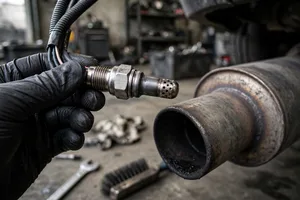
Bad oxygen sensor symptoms show up as a check engine light, poor gas mileage, rough idle, and a rotten egg smell from the exhaust. A bad sensor sends wrong readings to your engine computer, so your car burns too much fuel or too little. This guide covers the warning signs, OBD2 codes P0130 to P0167, repair costs in 2026, and when you should stop driving and get it fixed.
Your car feels off, but you cannot point to one clear fault. Bad oxygen sensor symptoms often start that way, with small changes you notice over a few weeks. Your gas mileage drops, the engine idles rough at a red light, or the car hesitates when you press the gas. The oxygen sensor sits in your exhaust system and measures how much oxygen is left in the exhaust gas. Your engine computer uses that reading to set the right air and fuel mix. When the sensor goes bad, the mix goes wrong. In this guide you will learn the warning signs, the codes a scan tool will show, the repair costs in the US in 2026, and how long you can safely keep driving.
What are the most common bad oxygen sensor symptoms?
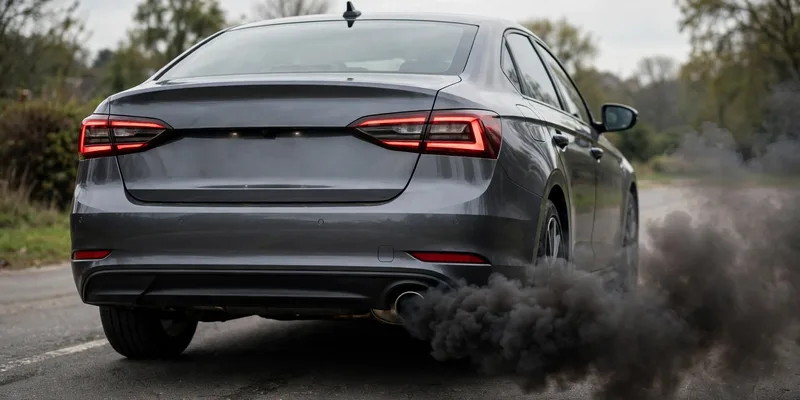
The most common bad oxygen sensor symptoms are a check engine light, poor gas mileage, rough idle, engine hesitation, black smoke, and a rotten egg smell.
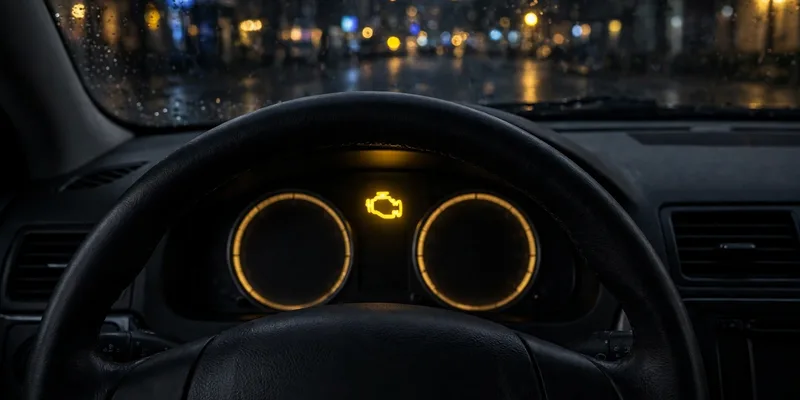
- Check engine light turns on and stays on. The light is often the first clear sign, and a scan will usually show a code in the P0130 to P0167 range. Do not clear the code and hope it stays off.
- Engine idles rough or stalls at stops. The idle may shake or dip so low the car stalls at a red light. One driver in Texas said his car shook at every stop, and a new sensor fixed it the same day.
Upstream vs downstream sensors
The upstream sensor controls the fuel mix, so a bad one hurts mileage right away. The downstream sensor only checks the converter.
Why does a bad oxygen sensor trigger the check engine light?
A bad oxygen sensor triggers the check engine light because the engine computer sees readings that are stuck, slow, or out of range. The computer turns the light on when it can no longer trust the sensor to control the fuel mix.
- Slow response is the most common cause. A sensor coated in carbon reacts late to changes in the exhaust. The computer sees the delay and turns the light on.
- A stuck voltage reading points to a dead sensor. If the voltage stays near 0.1 volts or near 0.9 volts and never moves, the sensor has failed. A 2018 Ford F-150 in Michigan showed exactly this pattern last winter. A shop will test it first, since a wiring fault can look the same.
- Wiring damage can mimic a bad sensor. Heat and road salt can damage the sensor wires near the exhaust. An Autel diagnostic tool (https://automotivescope.com/autel-diagnostic-tool/) shows live sensor voltage, so a tech can see the fault in real time instead of guessing.
How does a bad oxygen sensor affect gas mileage and performance?
A bad oxygen sensor hurts gas mileage and performance because the engine runs too rich or too lean. Most cars lose 10 to 40 percent of their fuel economy, and the engine may feel weak and rough.
- Fuel economy falls fast with a bad upstream sensor. The upstream sensor drives the fuel mix, so a bad one can cost a driver 5 to 12 miles per gallon. At $3.50 a gallon, that is $40 to $90 extra each month.
- Power drops and the car feels sluggish. A 2019 Honda Civic owner in Ohio said his car felt like it had lost a gear, and one sensor fixed it in 30 minutes.
- Emissions rise and the car can fail a smog test. A bad sensor can push carbon monoxide levels well past the limit, and this is often how the fault is found. A shop can confirm the reading with an automotive oscilloscope kit (https://automotivescope.com/automotive-oscilloscope-kit/) that traces the sensor waveform in fine detail.

What do bad oxygen sensor codes P0130 to P0167 mean?
Bad oxygen sensor codes P0130 to P0167 point to a fault in a specific sensor, bank, or heater circuit. P0130 to P0135 cover Bank 1 Sensor 1, and P0150 to P0155 cover Bank 2 Sensor 1 on V6 and V8 engines.
- P0130 and P0150 mean a sensor circuit fault. The computer sees a signal that does not make sense, often from a broken wire or a dead sensor. Check the plug and wiring before you buy a part.
- P0135, P0155, P0141, and P0161 mean a heater circuit fault. The sensor heater has failed or the fuse is blown. A shop in Florida sees this code often after a blown 15 amp fuse. The car may run fine once warm, yet the light stays on.

How a mechanic confirms the code
A good mechanic does not replace a sensor on the code alone. They watch live data and check the wiring first. A car makes clicking noise when turning (https://automotivescope.com/car-makes-clicking-noise-when-turning/) is a separate issue, and our guide to check transmission fluid at home (https://automotivescope.com/check-transmission-fluid-at-home/) shows a safe routine you can follow.
How much does it cost to replace a bad oxygen sensor in 2026?
Replacing a bad oxygen sensor costs $200 to $400 in total in the US in 2026, with the part at $50 to $250 and labor at $100 to $200.
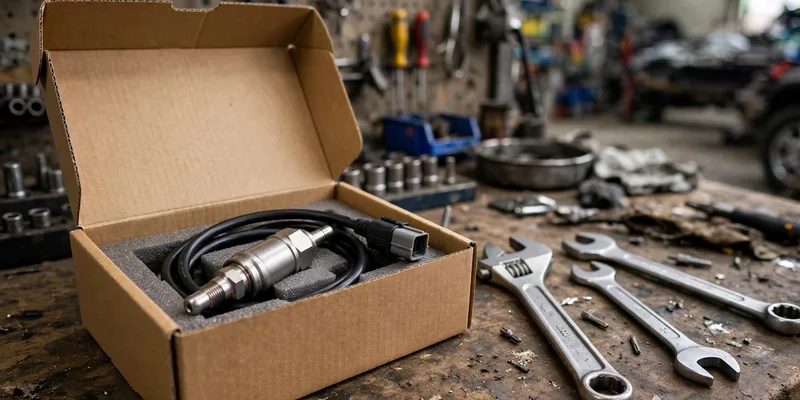
- DIY replacement costs $50 to $250 for the part alone. If the sensor is easy to reach, a home mechanic can swap it in 30 to 60 minutes with a $15 oxygen sensor socket. A Camry owner in Georgia did it in 40 minutes with basic tools.
- A shop job costs $200 to $400 for most cars. That covers the part, labor, and a code clear plus a short test drive. A dealer will charge more, often $350 to $550.
- Do not buy the cheapest sensor you can find. A $30 no name sensor may fail in 6 months. Stick to Denso, Bosch, or NGK, which are the brands most car makers fit at the factory. The auto repair shop profit margin guide (https://automotivescope.com/auto-repair-shop-profit-margin/) covers early diagnosis, and the cost to open auto repair shop guide (https://automotivescope.com/cost-to-open-auto-repair-shop/) covers shop startup costs.

Can you drive with a bad oxygen sensor?
Yes, you can drive with a bad oxygen sensor for a short time, but you should not drive for weeks. Short trips are fine, yet long drives risk converter damage and a stalled engine.
- Short trips under 20 miles are low risk. Drive to work, the store, and the shop for the repair. A nurse in Ohio drove hers to work for a week this way before the repair. Keep the speed steady and avoid hard acceleration, since that dumps more fuel into the exhaust.
- Stop driving if the light flashes or the car stalls. A flashing check engine light means a misfire is active. Pull over, turn the car off, and call for a tow.
- Do not drive if you smell strong fuel or rotten eggs. A strong fuel smell can mean unburned fuel in the exhaust. Our guide to a car smells like burning rubber (https://automotivescope.com/car-smells-like-burning-rubber/) can help you tell it apart from a burning smell under the hood.
If you own an older car, the guide to the classic car vs antique car difference (https://automotivescope.com/classic-car-vs-antique-car-difference/) can help you plan its care.
Frequently Asked Questions
What are the first signs of a bad oxygen sensor?
The first signs of bad oxygen sensor symptoms are a check engine light, a drop in gas mileage, and a rough idle. The car may also hesitate when you speed up or smell like rotten eggs. Most drivers notice the mileage drop first.
How long does an oxygen sensor last?
An oxygen sensor lasts 60,000 to 100,000 miles on most cars, with some lasting past 150,000 miles. Heat and oil leaks can shorten that life. If your car is past 100,000 miles and the light comes on, a worn sensor is a likely cause.
Can a bad oxygen sensor cause a car to stall?
Yes, a bad oxygen sensor can cause a car to stall at idle or at low speed. The wrong fuel mix can make the idle drop too low at a red light. Get the code read soon, since a stall in traffic is a safety risk.
How do I test an oxygen sensor at home?
You can test an oxygen sensor at home with an OBD2 scan tool that shows live data. A good sensor flips voltage between 0.1 and 0.9 volts several times per second. A slow or stuck reading points to a bad sensor.
Will a bad oxygen sensor fail an emissions test?
Yes, a bad oxygen sensor will often fail an emissions test, since it raises carbon monoxide and hydrocarbon levels past the limit. The check engine light alone fails the test in most states. Fix the sensor and drive 50 to 100 miles before the retest.
Can I replace an oxygen sensor myself?
Yes, you can replace an oxygen sensor yourself if it is easy to reach and not rusted in place. You need an oxygen sensor socket, penetrating oil, and a scan tool to clear the code. A shop can do a seized sensor in under an hour.
How many oxygen sensors does my car have?
Most cars have two to four oxygen sensors, with at least one upstream and one downstream sensor. Four cylinder cars usually have two, while V6 and V8 cars have four. A parts lookup by VIN will give the exact count for your car.
What happens if I ignore bad oxygen sensor symptoms?
If you ignore bad oxygen sensor symptoms, your gas mileage will keep falling and your catalytic converter can overheat and fail. A converter costs $1,000 to $2,500 to replace. The sensor costs $200 to $400 fitted, so early repair saves you a large bill.
Conclusion
So, in this article, we covered bad oxygen sensor symptoms in detail. You now know the warning signs to watch for, from the check engine light and poor gas mileage to rough idle and a rotten egg smell. You also know the codes P0130 to P0167, the repair costs in 2026, and why a quick fix beats a late one. My advice is simple: get the code read within a week of the light coming on, and do not drive for months with the fault. A $200 to $400 sensor job now can save you a $1,000 to $2,500 converter bill later. If this guide helped you, share it with a friend whose car shows the same signs, and check the next guide in our Auto Parts series for your next fix.


2 thoughts on “Bad Oxygen Sensor Symptoms: What to Look For in 2026”
Pingback: Why Does My Car Smell Like Burning Rubber
Pingback: How Much Does It Cost to Open an Auto Repair Shop